Beautiful Himachal (Hill Station)
Beautiful Himachal (Hill Station)
Program: HIMACHAL
Itinerary: (Arrive) Delhi/Chandigarh/Shimla/Manali/Dharamsala/Amritsar/Delhi (Departure)
Number of days: 11 NIGHTS / 12 DAYS
Validity Best time to visit April till Mid June & Mid September till December
Arrive in Delhi international airport where our representative will meet you at the arrival gates inside the airport and assist you to your hotel. Check in at the hotel. (Check in timings 1400 hours
Sightseeing of Delhi: Old Delhi, Jama Mosque, Red fort, Raj ghat, India gate, Presidential complex, Qutub Minar, Lotus Temple etc.. (visits will be a combination of photo stop and inside visits).
*** Red fort, Lotus temple closed on Monday
Overnight at the Hotel. Meal Plan (-/-/-)
Breakfast in the hotel. Later drive to Chandigarh, upon arrival in Chandigarh, check in at the hotel.
Overnight at the Hotel. Meal Plan (-/-/-)
Breakfast in the hotel. Later a full day sightseeing tour of Chandigarh.
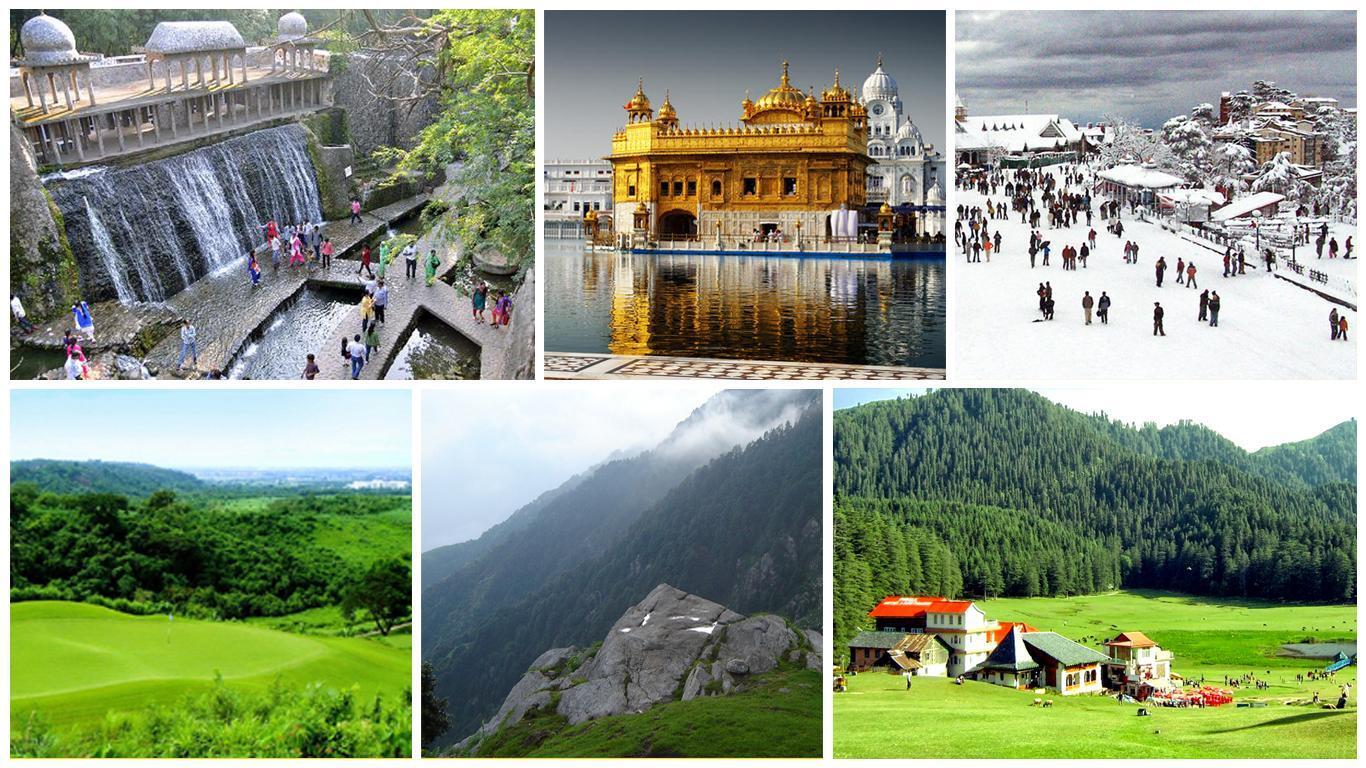
Rock Garden: Next to Sukhana Lake there is a unique but a world famous fantasy in the city of Chandigarh, called Rock Garden. Situated in the thick forest area, this garden holds its own charms for the visitors. It is full of objects built from household and industrial waste. There are no flowers or plants in this garden. The object to be seen there are the figure made of raw cement resembling humans and animals. These figures have been decorated with broken but colorful odds and ends of China clay. As one looks at them with deep intent, they seem to be staring as the visitors. They seem to be engaged in various activities. There are group of dancing damsels made from bicycle and motorcycle’s waste materials, marching armies of warriors resting flying or fledging birds made from countless bite of broken glass. There are groups of music bands engaged in their activity of entertaining the visitors. Its creator also needs a mention. The garden was visualized by Sh. Nek Chand. He belongs from gurdaspur district in Punjab province. He started his life in PWD as laborer, but late rose to high ranks. He came to Chandigarh as Road Inspector. His deep visualization made him to pick and collect all sorts of discarded scrap. He started to visit waste dumps of the factories. He collected there raw cement, broken pipes and other discarded matter. He created rapport with the truck drivers who carried and drop his debris at a vacant corner of the forest where now this unique creation stands. For twelve years he worked hard alone on this unique fantasy. After twelve years the work of Nek Chand noticed by Government. He was giving deserving patronage. An area of twelve acres was allotted for the extension of the original Rock Garden. Even funds were provided for carrying on the work.
Sukhna Lake: On the south eastern boundary of the city is the seasonal rivulet Sukhana choe. Water through it used to flow away in the rainy season. The planner of the city through their imagination, created a lake by obstructing the flow of rain water through the Sukhana Choe. A three and half km long dam was built to create a reservoir of water. Now known as Sukhna Lake. People generally come here for a morning or evening walk. It consists of an eating place, children’s park. It also has facility for boating and rafting for the adventure seekers. A major hit with children and grown-ups alike. At one end of the Lake are the premises of Lake Club. The club management takes care to provide facilities for water sports and recreational activities. Water sports become annual feature. Environment friendly people of Chandigarh take part in its disilting operation every year.
Shopping Centre: In the heart of the city, is located Sector 17. This is the main shopping center of the city though there are many government and private offices also. This commercial centre is fully pedestrianised. Here, the residents shop, lounges around or simply relax in the beautiful surroundings to enjoy the various fashion houses located here. Big showrooms and excellent departmental stores cater to the needs of shoppers. In evenings, one can see the crowd walking around here and there. The ultimate lightning effects are visible during the evenings.
Overnight at the Hotel. Meal Plan (-/-/-)
Breakfast in the hotel, later drive to Shimla. Upon arrival, check in at the hotel.
Overnight at the Hotel. Meal Plan (-/-/-)
Breakfast in the hotel. Today enjoy full day Shimla Local sightseeing, visiting Tara Devi hike, The Mall, Ridge, Viceregal Lodge and Jhaku Temple. o/n hotel
Tara Devi Hike(2100 mts.)
After breakfast drive to Tara Devi Bazar and accompanied by qualified escort/guide trek to Tara Devi Peak , Rich in flora and
fauna this is a moderate hike for about two hours, through a dense forest, and you reach the high point 2100 mts for excellent views of Shimla town.
Tara Devi – the Goddess of the Stars, Tara Devi has a temple dedicated to the Goddess of the Stars on top of a hill. Tara Devi is an ideal place for the person seeking a rest from the hectic life.
The Mall: The Mall is the main shopping centre of Shimla. It also has many restaurants, clubs, banks, bars etc. The Mall starts from Chhota Shimla to Viceregal Lodge, which is approximately five Km long stretch. This area has also been declared a ‘Heritage Zone’ by the State Government. The vehicles are not allowed into Mall road except ambulance and fire engines. There are many old beautiful buildings standing on Mall Road.
The Ridge: This large open space in the heart of town presents excellent views of the mountain ranges.
Christ Church: The most prominent building on the Mall is the yellow Christ Church built in 1857, reputed to be the second oldest church in northern India. It was designed by Colonel JT Boileau in 1844.
Scandal Point: Scandal Point remains the hub of Shimla’s social life; it is the place where people gathered for both conversation and gossip. Now it is also known as the meeting place of the local Shimla.
Viceregal Lodge (Built in 1888)/ Indian Institute of Advanced Study: Built Between 1884 – 1888 by chief architect Henry Irwin. The building resembles a Scottish baronial castle. This was the first building with electric light in Shimla. This was the venue of the Simla Conference in 1945. In 1947, the decision to partition India and East Pakistan (now Bangladesh), was taken here. After independence 1947, building became the property of the President of India and was renamed Rashtrapati Niwas. Now it houses the Indian Institute of Advance Study and is open only in some parts to the public. (closed on Monday and Gazetted Holidays)
Jhaku Temple/ Hill (2455 Mts.): Dedicated to monkey god Hanuman ji, the attendant of Lord Rama. This is the town’s highest peak at an altitude of 8048 feet above sea level and offers a panoramic view of the city and snow capped mountains.
Overnight at the Hotel. Meal Plan (-/-/-)
Breakfast in the hotel, later drive to Manali. Upon arrival, check in at the hotel.
Overnight at the Hotel. Meal Plan (-/-/-)
Morning Solang Valley hike.
Solang valley / 5 Hours Trek
Today the trek leads out of Old Manali village high above the River Beas along a well-defined path. We cross the two ancient villages of Shanag and Burua before reaching the beautiful Solang Valley which doubles as a Ski resort in winters.
Hadimba Temple/Doongri Temple: The temple is dedicated to the local deity Hadimba built in 1553 AD, and having four-tiered pagoda shaped roof and a front doorway carved with figures and symbols. Legend has it that the ruler who built this temple did not wish its carving to replicated, so he had the right hand of the artiest. It is believed that here Bhim, the great Pandava of the Mahabharata Epic killed the strong and cruel demon, Hadimb and married his sister Hadimba. Hadimba expurgated her all sins by performing a great Tapa, and consequently began to be worshipped as a goddess. A major festival is held here in the month of May.
Vashisth Hot Water Sulphur Spring: This is 3 km away from Manali and known for its pyramidal temple dedicated to Vashishta Muni, and natural hot water sulphur springs with two separate bathing tanks for gents and ladies.
Old Manali/Manu Temple: This is an original settlement with few old houses made of wood having slate roofs. There is also the Manu Maharishi Temple, dedicated to Manu, who was the creator of human race on the earth.
Overnight at the Hotel. Meal Plan (-/-/-)
Breakfast in the hotel, later drive to Dharamsala. Upon arrival, check in at the hotel.
Overnight at the Hotel. Meal Plan (-/-/-)
Breakfast in the hotel. Later a sightseeing tour of Dharamsala.
Naddi –Dharamkot-Bhagsu Nag Day Hike : Drive to Naddi , roads ends here and trek to Dharamkot through a forested path to Dharamkot. A three hours walk introduces you to the Gaddi lifestyle and the flora & fauna of the region.
Dharamkot is a small village inhabited by local people of Gaddi tribe. from Dharamkot it is about 4 kms walk through Deodar forest to Naddi village. The village provides a beautiful view of the Dhauladhar range. Trek further to Bhagsunag watetfalls
Bhagsunag Falls: At a distance of 2 km from upper town of Dharamshala, Bhagsunag can be approached by road; here an old temple, a fresh water spring, hotels and restaurants are located. Further about 2 km is beautiful Bhagsunag water fall which sooths one’s eyes.
Mcleod Ganj: Mcleodganj is a beautiful town on the top of Dharamshala, blessed equally nature and religion. Mcleodganj often called the ‘Little Lhasa’. This is the residence of His Holiness Dalai Lama, The Buddha temple is situated opposite to the present abode of His Holiness and it is the major centre for the studies of Tibetan culture.
St. John’s Church: The church of St. John’s in the wilderness lies on a motorable road between McLeod Ganj and Forsythe Ganj. It is a dressed stone church in whose courtyard lies the grave of Lord Elgin, one of the Viceroys of India who died at Dharamshala in 1863.
Bhagsunag Falls: At a distance of 2 km from upper town of Dharamshala, Bhagsunag can be approached by road; here an old temple, a fresh water spring, hotels and restaurants are located. Further about 2 km is beautiful Bhagsunag water fall which sooths one’s eyes.
Dal Lake: The Lake is located next to the Tibetan Children’s village 3 Km away from Mcleodganj. This is a small lake surrounded by Deodar trees.
Overnight at the Hotel. Meal Plan (-/-/-)
Early morning after breakfast, leave for Amritsar.
Afternoon visit
Attari-Wagha Border(28 Km) : The International Border between India and Pakistan lies 28 kms from Amritsar at Attari on the Grand Trunk Road and 24 Kms from Lahore. The border crossing draws its name from Wagha(Pakistan) and Attari (India) villages.
Wagha is a village located in the Wahgah Zone of Lahore, Punjab, Pakistan. It is situated 600 metres west of the border. It is 3 kilometres from the bordering Indian last village Attari. The Wagah railway station is 400 metres to the south and 100 metres from the border.
A flag-lowering ceremony is held here daily at sunset by both sides. The ceremony started in 1986 as an agreement of peace, although there was not a conflict at that time. The Wagha-Attari border ceremony happens at the border gate, two hours before sunset each day. The flag ceremony is conducted by the Indian Border Security Force (BSF) and Pakistan Rangers . Their steps are matched so perfectly that it is like watching a mirror image of the same exercise. The ceremony is a huge attraction for visitors and is poignant reminder of the partition of 1947 when Punjap was divided between two nations
Overnight at the Hotel. Meal Plan (-/-/-)
Breakfast in the hotel. Later visit Golden temple
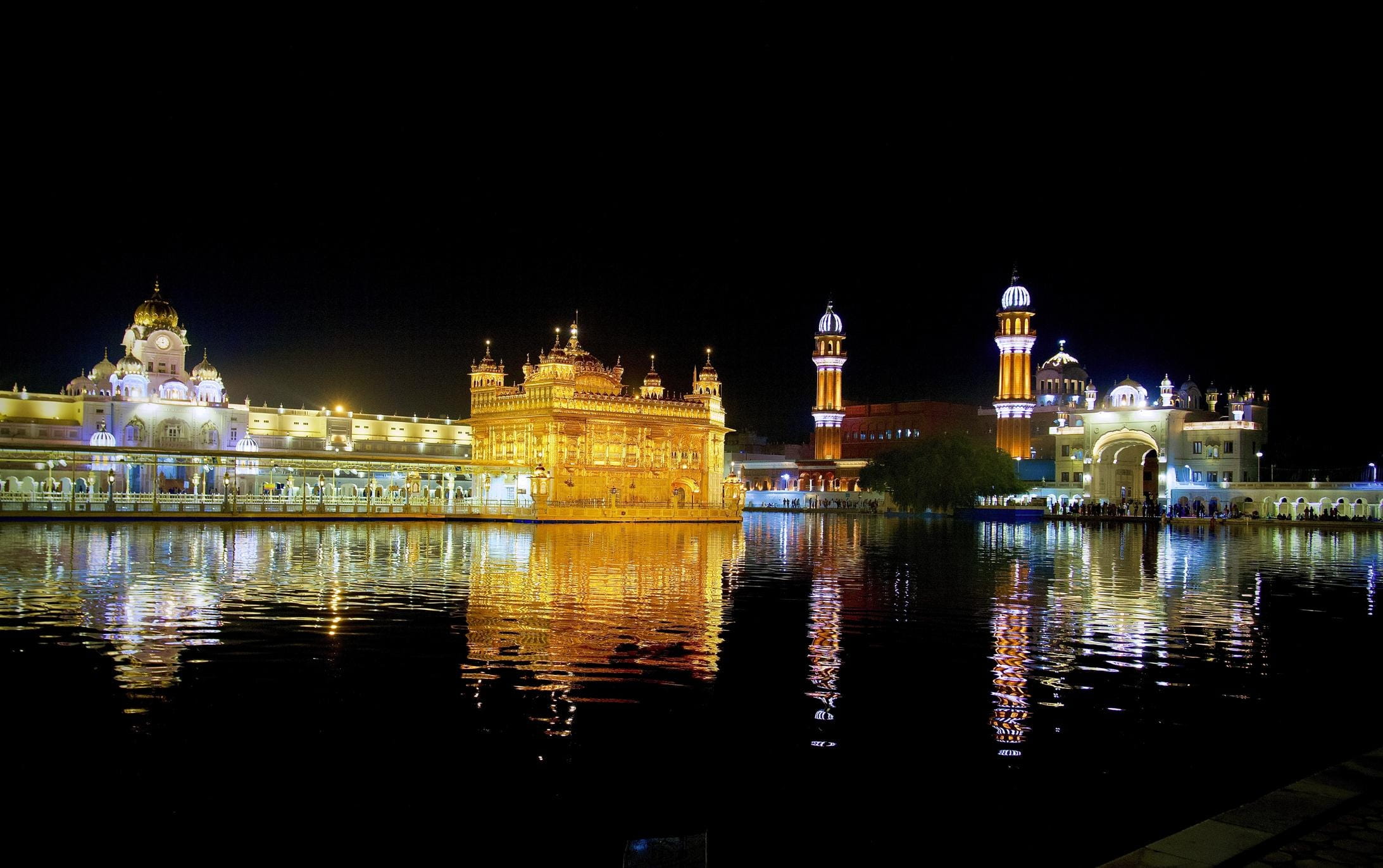
Golden Temple: The Golden Temple or ‘Hari Mandir’, situated in Amritsar, Punjab, is the most sacred pilgrim spot for Sikhs. The site of the temple was sacred to the Sikhs since the time of the 4th guru, Ram Das. Construction of the Amrit Sarovar (pool of nectar) was initiated by Guru Amar Das, the third Guru, in 1570 and was completed by Guru Ram Das, the fourth Guru. His successor, Guru Arjan Dev began work on the building after inviting Mian Mir, the Sufi saint, to lay its foundation stone in 1588. 1601 Harmandir Sahib completed. In 1603-1604, the first volume of the Guru Granth Sahib ji, was prepared in this city and was installed at Darbar Sahib on August 16, 1604.
The Akal Takht (The throne of immortality, lit. the never ending throne) the seat of Sikh political power was built by Guru Hargobind ji in 1606. Two flags representing temporal and spiritual authority and Sikh sovereignty were set up in front of the Akal Takht. Here Guru Hargobind ji wore two swords of Miri and Piri (temporal and transcendental authority) Around 1830, Maharaja Ranjit Singh had Muslim goldsmiths to gold-plate some parts of the inner section of the Darbar Sahib. The Gold plating led to it being called the Golden Temple.
All Sikh people try to make a visit to the temple and take bath in holy tank of the temple. kitchen and recitation of the divine word never cease here. Every day more than 25,000 people, (during special occasions 100,000 people) have free food in the ‘Guru-ka-langer’, irrespective of caste, creed, colour or gender.
Later transfer to airport/railway station to board the flight/train to Delhi. Upon arrival in Delhi, check in at the hotel.
Overnight at the Hotel. Meal Plan (-/-/-)
Today In time transfer to the international airport to board the flight to onward destination.
Namaste! Our services ends here, we look forward to welcoming you again!
Price Includes:
- Traditional welcome at the airport with Garlanding
- Welcome drink on arrival in the hotel
- Welcome kit includes (1 packet of wet-tissues + pen with a writing pad + documentation)
- Twin/Single/Triple sharing accommodation
- 11 Breakfast in the hotels
- Air-conditioned vehicle for all transfers, city tours and intercity travels (Non-Air-conditioned during Hill drive)
- English speaking local guides during the sightseeing tours
- Entrances to the monuments (One-time)
- Rickshaw ride at Old Delhi area during the sightseeing
- 2 mineral water bottles (500ml) during the tour per person per day
- Farewell gift
- All taxes
Price Excludes:
- Personal expenses / extra meals or beverages, Laundry, drinks, camera fee at monuments, poterage, tips etc
- Visa fee and any kind of Travel insurance
- Anything extra not mentioned under “includes” item